Did you ever look up the spiritual meanings of animals which come into your life? I began this when every journey I took was surrounded by deer. Was an awakening.
Right now my new abode is plagued with fruit flies. While not plentiful, annoying enough to have one or two fly past as I write this blog. Vinegar cures do not seem to work, nor chemical sprays. However, after reading this spiritual interpretation shall take them as a sign and a very positive message.
Here’s what Auntie Google has to say..
Fruit flies are the perfect symbols of spiritual growth and development, because they represent the process of metamorphosis. In the spiritual realm, a fruit fly is an individual who has undergone a profound transformation. They have gone from one state to another, and they are now able to see things in a new way.
As with all my adventures, you never know what you will find! Here I spent a fascinating 2 hours discovering how folks in the New York State farmlands once lived and worked.
There are many replicas of the era to see in this fine restoration. Let’s start with the Blacksmith Shop
In each area there is a video to explain the display.
The School House
Teachers in this era certainly had stern rules to live by. Take a read.
The store- This was the center of the community. Here people visited with others, got their mail, news of the day, and supplies.
Equipment of the era
Have wondered how Auburn became such a wealthy area. Got my answer from a friendly docent. Farmers often became industrialists with the inventions they created to ease their workload. Things such as parts for carriages, and farm equipment, rope, then there is the Burroughs adding machine, piano makers, time clocks and time pieces, steam agricultural and train equipment … All these ideas and inventions came from those in the Auburn area. There was even a woman inventor who developed a posture assistant.
An Auburn made piano.
Other pieces of equipment.
Beginnings of the Museum..
And now to Ward O’Hara the instigator of this fine museum. He began his career as a farmer then started a John Deere dealership in the area. He later became a congressman and with all the jewels he had received from his farmer friends (and stored) in his barn he had the makings for a museum. In his role as a legislator he developed the proposal for the museum, obtained the lands and viola the Ward O’Hara Museum was begun. Thanks, Ward.
His Model T Vehicles..
1922 Model T Ford
Also in the museum is Ward’s 102 year old Ford Truck which is still used for the museum’s June museum festival, occuring the first weekend. Sounds like fun and the docent gave me an invite for a ride during this event.
Some other interesting facets of the museum not to miss.
What an interesting visit. The Museum is open to school groups again starting in March, so glad to hear this. Kids need to experience the past.
One final blast from the past – the milkman truck. He delivered door to door.
Have been remiss in reporting on my visit to the Willard Chapel. Here is a bit of its history, but, to get the most information visit the Chapel web site https://www.willard-chapel.com/, and if you ever get a chance to visit – it is a must see. They also offer weddings in this Tiffany treasure. These weddings must be a stunning site and the cost reasonable.
Let’s start with the history of this amazing Chapel.
The daughters of industrialists Sylvester and Jane Frances Case Willard, had the Chapel built in memory of their parents at a cost of $50,000. in 1892, (constructed from 1892-1894). In today’s monies this would be $2 million, which is now the worth of one of the 14 Tiffany windows. The windows are protected on the outside with glass.
The Chapel and its decor is modern.
Some of the signature Tiffany green glass
The complex surrounding the Chapel was built in 1821 when there was a need for trained ministers. There were 76 students at the time who paid $1 a week for food and $5 for utilities monthly. By 1930, this rose to $6.5 board and $50 utilities. By 1939, the seminary was abandoned and transferred to NYC Union Seminary. After this time the buildings were used for Army training and later apartments for returning vets. By 1959, the seminary buildings were mostly demolished and others purchased the buildings, one being the 7th Day Adventists. When the Adventists decided to sell others proposed purchasing the Chapel for a bowling alley and/or disco. Recognizing the need to maintain this piece of history the community came to the rescue and bought the property.
Currently, the Chapel is undergoing a $5 million renovation project.
The Pulpit
The pews and flooring were designed by Tiffany. Each square of flooring was hand laid by women from the area.
Tiffany Lanterns
Tiffany designed chairs
This stained glass is a representation of Christ and St. Peter on the Sea of Gailee with the side panels the tree of life. There is no color in the glass, nor painting of glass. Tiffany technique used layering of glass to create color. Jesus in this Tiffany work was made to resemble Tiffany’s father. Tiffany never visited the Chapel, and the work was created and managed by Jacob Adolphus Holzer, with assist by Clara Driscoll, a Tiffany manager who managed the elite group known as the Tiffany girls.
The theme of the Chapel is faith, hope, and charity, but the greatest is love.
All in the Chapel is Tiffany except the organ. The Chapel is a National Historic Landmark.
After the debacle of internet, toilets, and insurance, decided I needed a get away. Drove to Ithaca, 35 miles south of Auburn, to view their waterfalls and for some nature relief.
First stop Buttermilk Falls, what a beauty and here are three views.
Next, Treman Falls, another beauty at Robert Treman State Park just a couple miles down the road from Buttermilk.
Final destination Ithaca Falls. WOW!
Check out the color of the sky. Reminded me of the Sistine Chapel and Michaelangelo’s colors.
On this rainy day decided to visit the historic Willard Chapel, and view the last known Tiffany Chapel. As a resident of St. Augustine, Florida, Tiffany is ingrained in my blood with the amazing windows of the now Flagler College.
Since arriving 10 minutes early the docent directed me to the following shop which is in the church office area. This amazing shop takes yarn, fabric, and needlepoint kit donations from the area, and points reaching New York City, and beyond.
What a treasure trove of goodies reasonably priced, and ready for the taking.
Here are some pictures of the shop.
Left here with an enormous bag filled to the brim for $40. I have enough fabric and things to do till I die!
What a spectacular cemetery and a must see for those cemetery enthusiasts. Here many prominent figures rest in peace.
The Chapel is at the beginning of the cemetery. While closed, was able to get a glimpse and picture of the Tiffany stained glass windows. Tiffany did much work in this area during this era.
The Cemetery began in 1851 with 22 acres, and the Chapel contains 14 Tiffany stained glass windows.
If you ever have the good fortune to visit the Cemetery, take a picture of this map to locate the sites of graves not to miss..
Some interesting headstones..
The Corning Family Plot
The Jewish section of the Cemetery. When people visit these headstones they leave a stone on top of the stone as a visit
remembrance.
The Seward Family Plot
The Harriet Tubman Plot – several family members are also interred around her. Note the heart of pinecones in front of the stone.
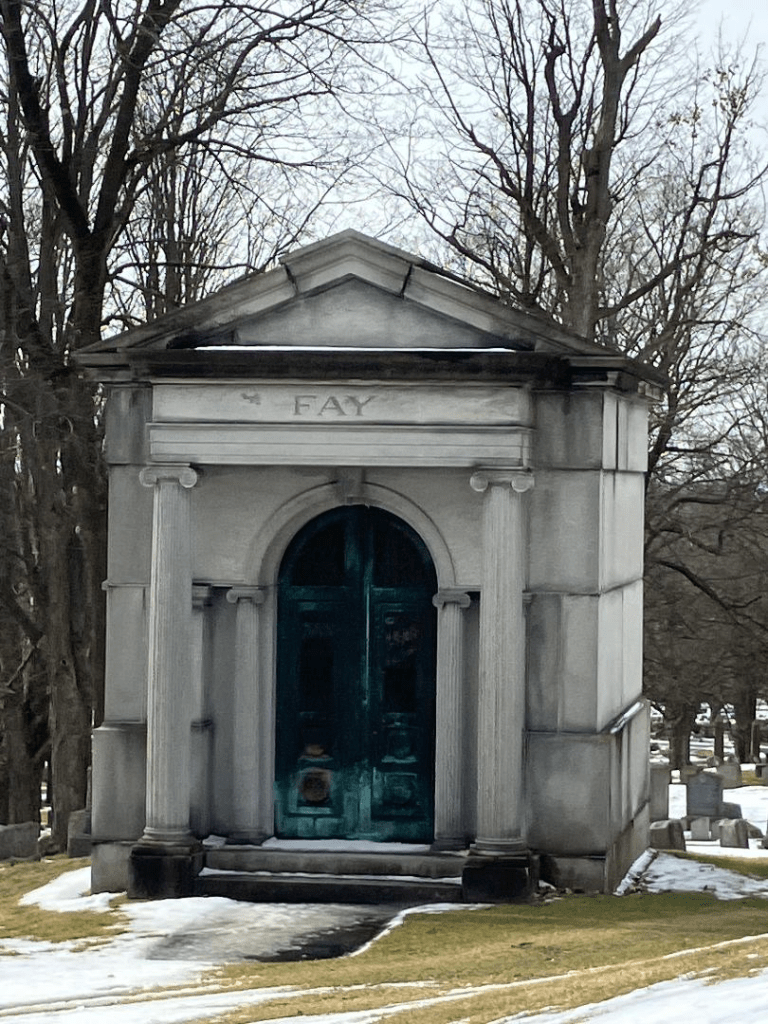
The Fay Family Mausoleum
The Fay family were industrialists who began their businesses selling gloves and mittens.
The Case Willard Family Plot – They began their fortunes in starch, and later their son, Theodore, a chemist, invented talkies.
Am living in a dorm setting in Auburn, N.Y. At 66, it is a different way of life being surrounded by 18-21 year olds who are attending Cayuga Community College. I am the grandmother. Ha! Ha! The living area is communal with a couch, television, dining room, full kitchen minus an oven, a toilet and two showers for 4 tenants. Am doing things I should have done in my youth, but for $500. a month, no security deposit, the place is a real deal for a travel nurse.
After 3 weeks of living the bachelorette life another travel nurse has moved into the quad. And she came with a bundle of love, Mags. Living with a dog is an experience which I miss, however, am unable to make this full time commitment to a pooch.
Mags sitting on the chair as I exercise.
While my roommate is doing day orientation, Mags comes to visit as soon as she leaves. Mags is a female mutt, and a delight. Have no complaints about this lovely bitch, (she’s a female), and I already know will miss dog love once the 13 week gig is up.
After an interesting 12 hour night shift woke and decided to take a walk. Auburn has many gorgeous Gothic Mansions of the 1800-1900 era on the street where the Seward Mansion lies so headed in that direction. Here I found the home of the Fay Family.
Here were 2 gorgeous homes of Fred Fay, the son of Edwin, who made his fortune in glove and mitten manufacturing. Edwin later turned to banking through Auburn Savings Bank and Fred continued in these footsteps.
Another prominent Auburn resident had his home on this street.
This is the second Secretary of State to reside on this street. Under Eisenhower Dulles constructed many Cold War policies post World War II with the Soviet Union. He was Wilson’s legal counsel at the Versailles peace talks at the end of World War I and helped prepare the United Nations charter. A Princeton graduate he was also educated at the Sorbonne and specialized in international law.
XXXXX
The Theodore Willard Case Home
This grandiose home is now on the grounds of a Presbyterian retreat, however, a spectacular grotto of the Virgin Mary remains on the property.
Mr. Case was a chemist and inventor of the sound on film processes. Auburn born into a prominent family, and educated at Yale, he joined forces with Fox for the creation of “talkies.” He died at 55 and is buried in the Fort Hill Cemetery in Auburn, New York. Looks like another spot for me to investigate.






 Young Retiree Needs a Life